Sunday, January 31, 2016

Research Information on "Digital Sound and Music in Computer Games" 1987-2000

Source: http://3daudio.info/gamesound/history.html

Importance: Absolutely essential


  • 1987 - NEC TurboGrafx-16 released
    • 6 digitized sound channels
    • 2 sound channels for ADPCM-compressed samples
    • First console to support stereo output
    • First console to use a CD-ROM w/ an attachment, allowed developers to to create more realistic music and sounds in games
  • 1989 - Nintendo's Game Boy released, innovated portable console market
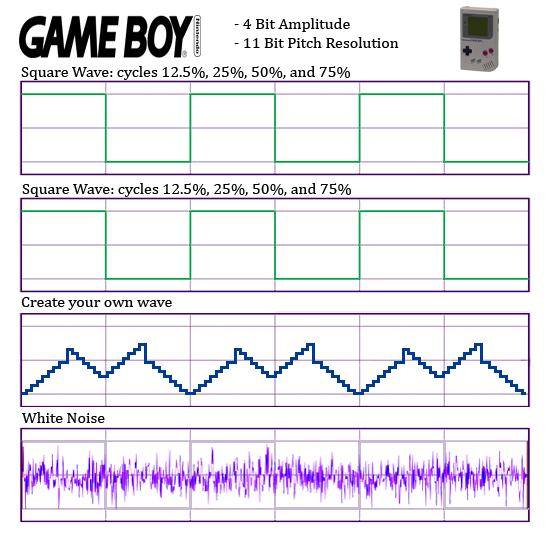
  • 1 channel offering 4-bit sound samples
    • 3 PSG (Programmable Sound Generator) channels
    • 1 White Noise channel
    Image: http://www.originalsoundversion.com/inverse-phases-music-from-old-sound-chips/
  • 1989 - Sega Genesis/Mega Drive released
    • 6 channels powered by a Yamaha synthesizer chip
    • 4 channels powered by a PSG chip
    • 1991 - Sega CD add-on released,
      • Added 8 PCM sound channels to playback recorded sound
      • CD-ROM technology and added PCM channels allowed pre-recorded music to be put into games
  • 1991 - SNES released
    • Had a digital signal processor that can mix up to 8 voices at once and change the pitch and volume of each voice
    • Each voice powered by a small pre-recorded instrument sample
    • A special program tells the DSP which samples to play and which to alter the pitch/volume of
      • Similiar to MIDIs
  • 1993 - Panasonic 3DO released
    • First CD only console
  • 1994 - Soundtrack for game Tempest 2000 was released as a CD to be sold
    • First instance of a commercially sold soundtrack for a video game
  • 1994 - Sega Saturn released
    • 32 channels of CD quality audio (16-bit 44.1kHz)
      • Had limitations: Audio samples have to be decompressed to the internal audio memory buffer of 512k before being used, limited quality and/or amount of audio samples that can be played at the same time
    • 32 MIDI channels
    • 32 channels powered by a Yamaha synthesizer
  • 1994 - Sony Playstation released
    • 24 channels of CD quality audio
    • Allowed for real-time effects (Pitch modulation, digital reverb, amplitude envelopes)
    • Support for MIDI
    • Audio didn't have to be decompressed like Saturn
    • Audio memory buffer of 512kb
  • 1996 - Nintendo 64 released
    • Unlike other consoles at the time, used cartridges instead of CDs
      • Limited storage, usage of sounds and speech can't be as extensive compared to Saturn and Playstation
    • No unique audio chip, audio is handled by CPU and other processing chips
      • Played 16-bit 48kHz audio
      • Number of channels not defined, depends on software
      • Filters and effects can be added to sound
  • 1998 - Sega Dreamcast released
    • Used a GD-ROMs, similar to CD-ROM, but had 1.2 GB storage instead of 700 MB
    • Two sound processors create 64 channels of CD-quality sound
    • Audio no longer needs to be decompressed before using
    • Audio memory buffer of 2 MB
    • Allowed for real-time effects to be added
  • 2000 - Sony PS2 released
    • Used a DVD-ROMs, typically 4.7 GB
    • 2 MB sound memory
    • Had one soundchip with 48 channels of 16-bit 48kHz audio
    • Also supports 8 channels of surround sound, making it the first console with multi-channel surround sound
This article details the hardware capabilities of important video game systems, and how they affected the ways developers could implement music. This article is very important since it gives a detailed history of the beginnings of sound in video games, the rise of music in them, and eventually the evolution of video game music as the audio capabilities of gaming systems advanced. This is exactly what I need for my investigation.

Sunday, January 24, 2016

Research Information on "Digital Sound and Music in Computer Games" 1930-1985

January 24 2016

Research Information on "Digital Sound and Music in Computer Games"

Source: http://3daudio.info/gamesound/history.html

Importance: Absolutely essential


  • 1930 - Baffle Ball, the ancestor to all pinball machines, utilized artificially generated sounds to produce noise
  • May 24 1972 - Magnavox Odyssey, the first video game system, featured no sound
    • No integrated circuits kept costs low, but no sound
    • Huge success though
  • June 27 1972 - Atari company formed, tested concept for Pong at a local bar with coin slot
    • No music, only made a "pong" sound when the ball hit a paddle
    • By the end of 1973, 25 companies were producing games similar to Pong
  • 1975 - Atari's home version of Pong became a massive success
    • Formed a new industry
  • 1972 - Atari released Touch Me, had 4 blinking buttons that the user had to press in the order they blinked
    • MB bought the idea and turned into Simon, which had added sound, and it became a huge success
      • Signifies importance of sound in electronic entertainment
  • 1977 - Atari 2600 release, had a chip named Stella that handled sound
    • Stella had 2 audio circuits that could be programmed independently
    • 5-bit register means only 32 unique sounds possible
    • Sound output could be controlled by volume, pitch, and tone, allowing primitive music to be made (http://3daudio.info/gamesound/files/acid_drop.mp3)
  • 1980- First competitor of Atari 2600, Mattel Intellivision, made
    •  3 separate sound channels controlled by pitch, volume, and attack/decay patterns
    • Also had a noise channel
    • 12-bit register meant there were 4096 possible sounds, pitch-perfect songs can be made (http://3daudio.info/gamesound/files/sharkshark.mp3)
    • Sound chip in this system used in many later systems
    • Had an extension called the Intellivoice, allowing computer-synthesized speech to be played (http://3daudio.info/gamesound/files/mattel.mp3)
  • 1978's Space Invaders and 1980's Pac-Man became a worldwide success, introduced electronic video entertainment to many
  • 1985 - NES introduced to US after a video game crash in 1983, 1 in every 4 houses had an NES by 1989
    • Had no soundchip, analog circuitry controlled sound
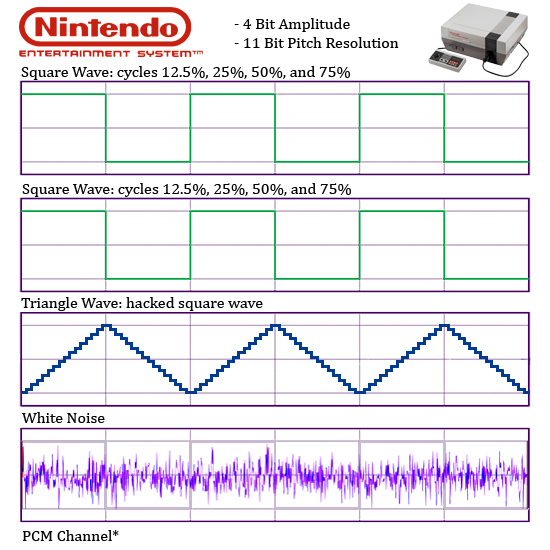
    • Total of 5 sound channels
    • Image: http://www.originalsoundversion.com/inverse-phases-music-from-old-sound-chips/
      • 2 square channels (Produces sound waves that look like squares)
      • 1 triangle channel (sound waves look like triangles)
      • 1 noise channel
      • 1 channel to playback samples (Not used often because samples used up a lot of space at the time)
  • 1987 - NEC TurboGrafx-16 released
    • 6 digitized sound channels
    • 2 sound channels for ADPCM-compressed samples
    • First console to support stereo output
    • First console to use a CD-ROM w/ an attachment, allowed developers to to create more realistic music and sounds in games
  • 1989 - Nintendo's Game Boy released, innovated portable console market
  • 1 channel offering 4-bit sound samples
    • 3 PSG (Programmable Sound Generator) channels
    • 1 White Noise channel
    Image: http://www.originalsoundversion.com/inverse-phases-music-from-old-sound-chips/
  • 1989 - Sega Genesis/Mega Drive released
    • 6 channels powered by a Yamaha synthesizer chip
    • 4 channels powered by a PSG chip
    • 1991 - Sega CD add-on released,
      • Added 8 PCM sound channels to playback recorded sound
      • CD-ROM technology and added PCM channels allowed pre-recorded music to be put into games
  • 1991 - SNES released
    • Had a digital signal processor that can mix up to 8 voices at once and change the pitch and volume of each voice
    • Each voice powered by a small pre-recorded instrument sample
    • A special program tells the DSP which samples to play and which to alter the pitch/volume of
      • Similiar to MIDIs
  • 1993 - Panasonic 3DO released
    • First CD only console
  • 1994 - Soundtrack for game Tempest 2000 was released as a CD to be sold
    • First instance of a commercially sold soundtrack for a video game
  • 1994 - Sega Saturn released
    • 32 channels of CD quality audio (16-bit 44.1kHz)
      • Had limitations: Audio samples have to be decompressed to the internal audio memory buffer of 512k before being used, limited quality and/or amount of audio samples that can be played at the same time
    • 32 MIDI channels
    • 32 channels powered by a Yamaha synthesizer
  • 1994 - Sony Playstation released
    • 24 channels of CD quality audio
    • Allowed for real-time effects (Pitch modulation, digital reverb, amplitude envelopes)
    • Support for MIDI
    • Audio didn't have to be decompressed like Saturn
    • Audio memory buffer of 512kb
  • 1996 - Nintendo 64 released
    • Unlike other consoles at the time, used cartridges instead of CDs
      • Limited storage, usage of sounds and speech can't be as extensive compared to Saturn and Playstation
    • No unique audio chip, audio is handled by CPU and other processing chips
      • Played 16-bit 48kHz audio
      • Number of channels not defined, depends on software
      • Filters and effects can be added to sound
  • 1998 - Sega Dreamcast released
    • Used a GD-ROMs, similar to CD-ROM, but had 1.2 GB storage instead of 700 MB
    • Two sound processors create 64 channels of CD-quality sound
    • Audio no longer needs to be decompressed before using
    • Audio memory buffer of 2 MB
    • Allowed for real-time effects to be added
  • 2000 - Sony PS2 released
    • Used a DVD-ROMs, typically 4.7 GB
    • 2 MB sound memory
    • Had one soundchip with 48 channels of 16-bit 48kHz audio
    • Also supports 8 channels of surround sound, making it the first console with multi-channel surround sound
This article details the hardware capabilities of important video game systems, and how they affected the ways developers could implement music. This article is very important since it gives a detailed history of the beginnings of sound in video games, the rise of music in them, and eventually the evolution of video game music as the audio capabilities of gaming systems advanced. This is exactly what I need for my investigation. This article also lists various sources on the page http://3daudio.info/gamesound/index.html. This helps boost the reliability of this source since it has proper evidence that it references.

Saturday, December 12, 2015

Research Information on "How Video Games Changed Popular Music"

Source: http://www.newyorker.com/culture/cultural-comment/how-video-games-changed-popular-music

Importance: Very Useful

  • Around the time of the Atari 2600, video game music used to be composed by the developers
    • Not enough memory to hold complex soundtracks
    • Many games didn't have music
  • 1984- By the time Kondo worked at Nintendo, hardware capabilities evolved
  • Kondo decided the sound-design in Super Mario Bros should emphasize the experience of the player
  • Kondo caused video games to become both a visual and audial experience
  • As technology grew to the 16-bit era, music became a way to make ones game distinct from the others
  • Major game companies began hiring musicians for their games, even hiring popular musicians for their work
  • Soundtracks reached outside the realm of video games
    • Ex: Final Fantasy soundtrack grew popular enough to be played in concerts
This article provides some more information on how video game music grew to be of more importance to the general public, though it still lacks information on the hardware aspect. It lists how video game music was seen in different ways before today, but doesn't explain how the audio capabilities of hardware affected video game music. It's useful, but leaves areas untouched.

Research Information on "A Brief History of Video Game Music"

Source: http://www.mfiles.co.uk/video-game-music-history.htm

Importance: Very Useful

  • Koji Kondo's soundtrack for Super Mario Bros on NES revolutionized the video game music genre
    • Didn't start it though
  • Kondo utilized clever techniques not done before
    • noise channel in the NES sound chip created percussion
    •  Distinct sounds given to the melody, harmony, bass, percussion
  • 1990s- Personal Computer rising in gaming
  • 1991- PC game Myst was composed using synthesizers
    • First PC game with music that won an award
  • Computer MIDIs also used to produce music
    • Ex: 1993- FPS Doom
  • 1998- Heart of Darkness changed the course of video game music, was the first soundtrack in a video game recorded from an actual orchestra
  • More and more video game series' received fame for their soundtracks
    • Grew to the point where famous musicians tried their hand on video game music
  • Video game soundtracks were being released on CD
This article is more useful than the previous one by giving some important figures and also pointing out some milestones in how video games were perceived, such as the first PC game to have a soundtrack receive an award. Though, this still doesn't focus too much on the hardware aspect of video game music. It's likely that I'll need to investigate further to find everything I need.

Research information on "The Evolution of Video Game Music"

Source: http://www.npr.org/templates/story/story.php?storyId=89565567

Importance: Interesting
  • Video games didn't always have music
    • Ex: 1970s Pong
  • Music implemented to set mood
    • Ex: Space Invaders- "Music" grew faster as aliens got closer
  • Limited by hardware initially
  • Implementation of CD-ROMs for video game medium caused video game music to resemble real music
This article was interesting in relation to the topic I'm researching, though it's not entirely essential. The article provides only a small amount of information, and doesn't really give a good idea of the evolution of video game music by itself. Overall, this article provided some information, but not enough to give me a good idea of my topic. It's a good start, but it leaves many open areas that need further exploring, such as what kinds of limitations the hardware in gaming systens had. 

Saturday, November 21, 2015

2nd Discussion with Supervisor

November 20 2015

2nd Discussion with Supervisor

During the discussion with my supervisor, she strongly suggested that I need to record the process I've done for my investigation into my process journal, so that'll be my top priority for now.  She also suggested that I decide soon whether or not I conduct a survey as part of my investigation. Looking at my plan for the personal project, she approved of it, and liked the fact that I accounted for finals in my plan. She wrote some comments on it such as when I should write the survey if I need to do one, when to deliver the survey, and when to discuss about it. A concern she had was whether or not I could complete my product in the span of two weeks. Looking ahead, my product is most likely going to a digital work rather than a physical one, so I believe that it won't be as time consuming since I'm working with a keyboard and mouse rather than an abundance of materials for the product.

Sunday, October 25, 2015

Discussion with Supervisor

October 23 2015

Discussion with Supervisor

My initial idea was to investigate how video games have shaped culture, with the global context being scientific and technical innovation. However, after discussing with my supervisor about it, I realized that my goal was too vague, and that I should be more specific about it. Through the discussion with my supervisor, I decided to amend this to be more specific towards video game music. My goal is now to investigate how music in video games have evolved as a result of advances in the audio capabilities of video game consoles, with the global context being the same.